
Seminole County Busted Mugshots
Every Seminole County booking photo starts at one place. That is the John E. Polk Correctional Facility, known locally as JEPCF. The arrest itself can come from several agencies. Seminole County Sheriff's Office, Sanford Police, Altamonte Springs Police, and Oviedo Police all book people into the same county jail. Once someone arrives, SCSO corrections staff build the jail record and snap the identification photo. The arresting agency keeps its own incident report, separate from the jail sheet. Remember that split when you need more than the booking line itself.
A jail entry holds only a few things. It lists the booked name, the charge, custody status, bond details, and the arresting agency. For the court side of a bust, turn to the Seminole County Clerk criminal case search, which tracks filed charges from filing through final outcome.
A note on accuracy: match the booking number, age, and agency before assuming any jail entry describes the person you have in mind.
Seminole County Booking Record Fields
The official portal shows a compact result first, then links the booked name to a fuller detail page. A shared name proves nothing. Check the age and any other descriptors the listing offers, and lean on the booking number whenever you have it. Jail entries stop at the booking facts. Court dates and final outcomes live with the Clerk instead.
| Field | What it means |
|---|---|
| Name and descriptors | The identity and demographic details recorded at intake. Use several fields to avoid a same-name error. |
| Booking number | The jail’s specific identifier for that intake event and the strongest roster search key. |
| Custody status | Whether the portal places the record among current, released, or all searchable records. |
| Booking and arrest data | The intake event and agency information, not the later court judgment. |
| Charges as booked | Charges presented to the jail. Prosecutors may file different charges or none. |
| Bond information | The release condition shown by the jail. A $0.00 value can have several meanings and must not be read as a free release. |
| Current photo | The identification image displayed for a current inmate under SCSO’s stated media policy. |
The SCSO custody search has a caveat. It may not reflect decisions by the State Attorney or what happened at trial. A status of "Released" only means the person left county custody that day. The "All Records" option widens the net. Still, SCSO makes no promise about how far back the online archive reaches.
Request Seminole County Booking Photos
Start with the online detail page for anyone currently held at JEPCF. Once a person is out, the path changes. SCSO's Media Information page routes booking-photo requests to the Public Information Unit. A fuller jail record comes through the SCSO Public Records Unit. Name the exact item you want. A city police report and a county booking photo often sit with different custodians.
- Collect the booked name, an approximate date, booking number if known, arresting agency, and the item sought.
- Ask for the “booking sheet and booking photograph” and give a narrow date range. Electronic delivery may reduce copying.
- Submit through the SCSO portal, in person, by phone, email, or mail. Ask for an estimate before chargeable extensive work.
- If the arresting agency was a city department, send a separate request there for its incident or arrest narrative.
- Check the Clerk record for filed charges, later hearings, judgment, and disposition.
100 Eslinger Way
Sanford, FL 32773
(407) 665-6690
records@seminolesheriff.org
Monday through Friday, 8 a.m. to 5 p.m., holidays excluded
Copies from SCSO follow a set fee schedule. A one-sided black-and-white page costs 15 cents. Double-sided runs 20 cents. Color is 25 cents one-sided and 35 cents for both sides. Certification adds $1. Extensive research may require a deposit, and video, audio, and crime-analysis work carry separate charges. Expect a timely response rather than a fixed day count, since volume, staffing, exemptions, and redaction all shape how fast a request moves.
Florida Mugshot Law and Removal
Florida's open-government foundation sits in two places. One is Constitution article I, section 24. The other is Florida Statutes section 119.07. Together they guarantee access to nonexempt records. Access is one thing; permanent publication is another, and nothing requires SCSO to leave every mugshot online forever. Juvenile files stay confidential under section 985.04, subject to statutory exceptions. Other exemptions shield victims, witnesses, active investigations, addresses, and security data. A lawful redaction differs from a claim that no record exists at all.
Florida Statutes section 901.43 targets commercial booking-photo publishers. A covered site may not charge to take an image down. The photographed person or a legal representative sends the registered agent a written request by registered mail. It must include proof of identity and enough detail to locate the photo. When the statute applies, removal is free and must finish within 10 calendar days. The law does not force deletion by every sheriff or news outlet.
Fix the official record first if it contains an error. Sealing or expunction is a separate court process. It begins with the FDLE Certificate of Eligibility process, which FDLE says takes roughly 12 weeks and guarantees nothing. Eligibility turns on the full case history under sections 943.0585 and 943.059. Recently Booked and Mugshots.com both publish free document-based takedown routes, yet an independent copy can survive after the government source changes. Skip removal sellers entirely. After a source page comes down, cache-refresh tools at Google or Bing can clear a stale search listing, though the underlying record still stands.
How Fast Busted Bookings Appear
Two official clocks govern Seminole County bookings. The custody roster is one search, but SCSO publishes no refresh interval and never calls it real time. The dated booking report uploads around 8 a.m. each weekday and captures intake since midnight of the prior business day, with Monday's file sweeping up the weekend. A Saturday arrest can thus show in the custody portal well before it lands in the report archive.
Florida Rule of Criminal Procedure 3.130 requires first appearance within 24 hours for anyone still held. SCSO posts local sessions at 1:30 p.m. on weekdays and 9 a.m. on weekends at JEPCF, though those hours can shift. First appearance handles rights and release conditions. The official booking-photo and report policy spells out the full schedule.
One sheriff source anchors it all. Current photos, requests for released photos, weekday booking reports, and first-appearance timing trace back to the same official policy.
Seminole County Booking Scale
How big is the operation? The SCSO Corrections page lists a design capacity of 1,396 at the John E. Polk Correctional Facility. It also reports more than 20,000 bookings in a typical year. Each booking is an event, not a person, so the two figures describe workload rather than headcount. The population itself is a mix. Some are pretrial defendants facing felonies or misdemeanors. Others are serving misdemeanor sentences. Convicted felons wait here for transfer to state prison, and a few federal detainees round out the count. One shared building holds people at very different legal stages.
Scale explains why searchers should pin down an exact booking number and a tight date range. It does not back up claims about local crime rates, tallies of convictions, or trends in any single city.
Find Seminole County Busted Mugshots
Custody status drives the search order. Freshly booked? Start with the county roster and the newest daily report. Released? The person may still surface under Released Inmates or All Records, with a photo available on request. A Florida prison sentence moves the record to FDC. Federal custody calls for a federal locator. Every step stays with the agency that holds the record.
- Search the SCSO portal by booking number or name. Start with Current Inmates and confirm several identifiers.
- Try Released Inmates and All Records if current custody returns no match.
- Check the dated booking-report archive using the likely intake date and its business-day schedule.
- Request an older photo from SCSO and the incident report from the listed arresting agency.
- Use the Clerk docket for filed charges and disposition. Use FDC, BOP, or ICE only when that custody type applies.
Empty results prove nothing. A search can miss because of a nickname, a missing status filter, or a process that never touched JEPCF, such as a notice to appear. Try formal spellings, then vary the status choice. Also keep identifiers separate: the jail booking number, the police report number, and the Clerk case number come from three different systems and do not match each other.
Where Seminole County Mugshots Appear
Start with official channels. They name the custodian and show a record's current status. News sites and commercial pages can lag behind. An old claim may stay up long after the official case has moved on.
| Channel | Photo? | Status and access |
|---|---|---|
| SCSO custody portal | Yes for current details | Official county current, released, and all-record filters. |
| Daily booking reports | Not the documented photo route | Official weekday intake chronology with booked charges and arresting agency. |
| SCSO Public Information Unit | By request | Official route for a released person’s booking photo. |
| FDC Offender Search | When available | Official state-prison or state-supervision record, not county intake. |
| VINELink | No photo archive | Custody-status notification where participating data are available. |
| Busted Newspaper | Often | Unofficial county page that can be stale or incomplete. |
| Recently Booked | Often | Unofficial rolling page; verify both identity and later disposition. |
| Mugshots.com | Varies | Unofficial archive visibly dated through 2022 during research. |
| Arrests.org and Mugshots.zone | Unverified | County routes existed, but access and freshness could not be confirmed. |
The Recently Booked county view documents one secondary route.
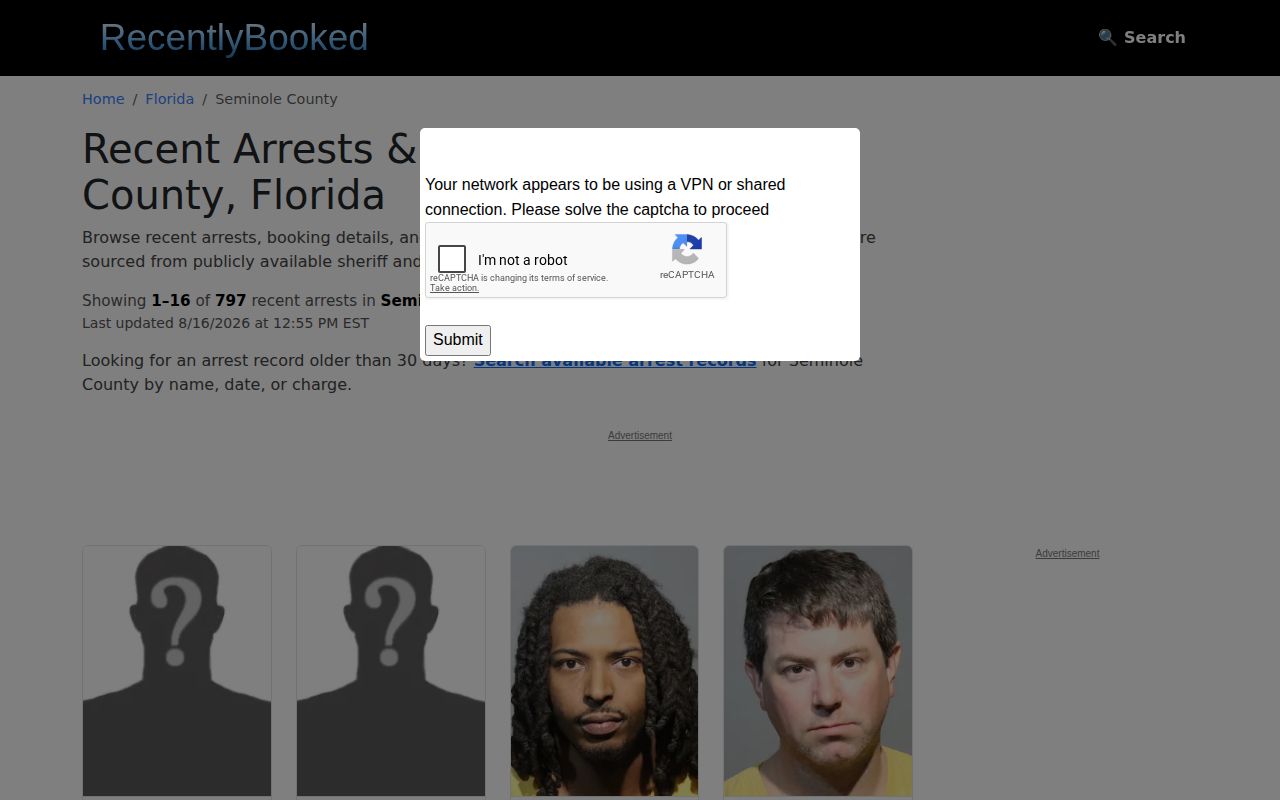
Treat any screenshot as context only. For custody status and case outcome, SCSO and the Clerk remain the sources that count.
Search Seminole County Busted Roster
The roster form takes a last, first, and middle name, plus age, race (B/W), gender (F/M), and a booking number. A status menu offers Current, Released, or All Records. Results begin with name, age, race, and gender, and clicking a name opens the full entry. According to SCSO, current entries include the mugshot.
| Search field | Best use |
|---|---|
| Booking number | Most specific search when the jail identifier is known. |
| Last, first, middle | Core name search; add fields only when needed. |
| Age, race, gender | Result narrowing and identity comparison, not proof by itself. |
| Current Inmates | People presently shown in county custody. |
| Released Inmates | People who left custody, without implying a case outcome. |
| All Records | Broader online search with no promised historical span. |
The live Seminole custody portal shows the official search interface.
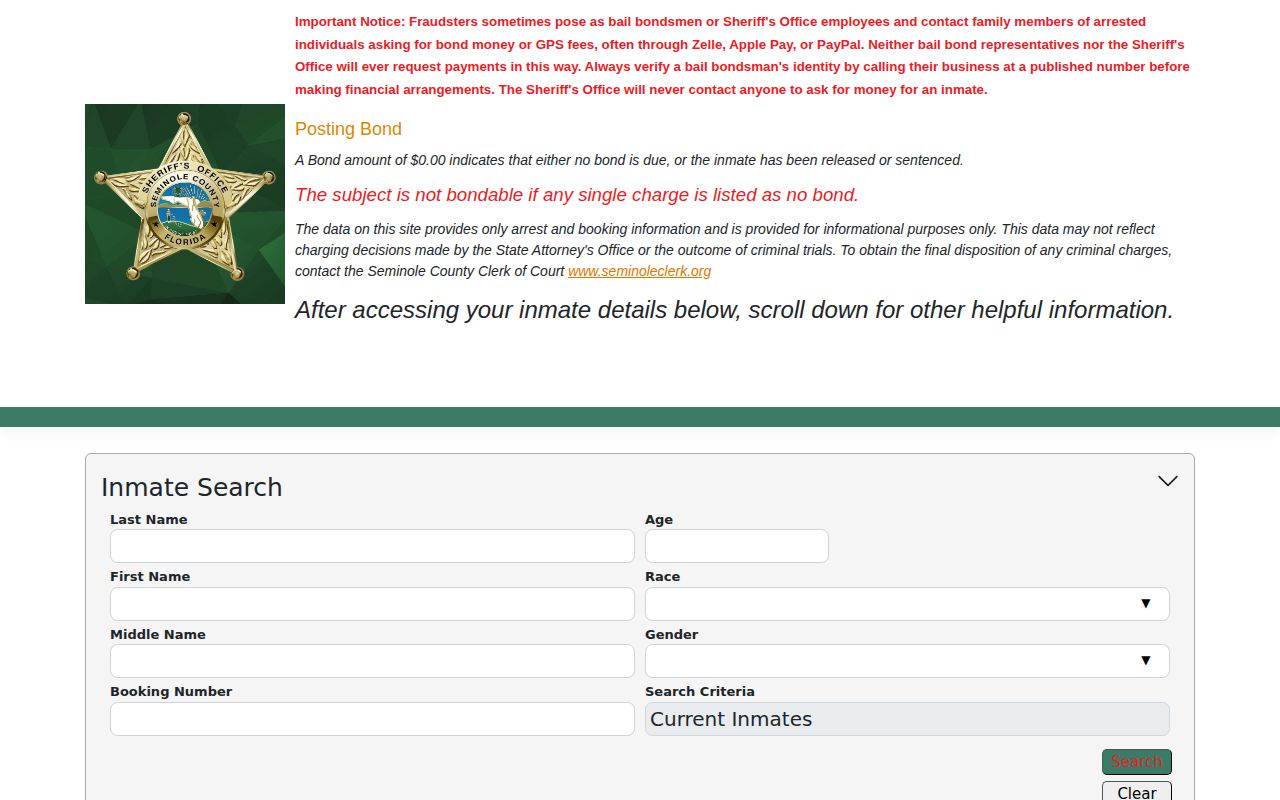
Those status controls beat a current-only list. Just know the limits: SCSO posts no refresh interval and no fixed lookback window for the roster.
Busted Weekend Booking Reports
This is a business-day report series, not a rolling 24-, 48-, or 72-hour dashboard. Around 8 a.m. each weekday, SCSO posts everyone booked since midnight of the prior business day. Monday matters most for weekend arrest coverage. That single issue sweeps up Saturday and Sunday. Each listing shows charges as booked plus the arresting agency, including municipal departments whose detainees landed at JEPCF. The year-organized booking-report archive is the official feed.
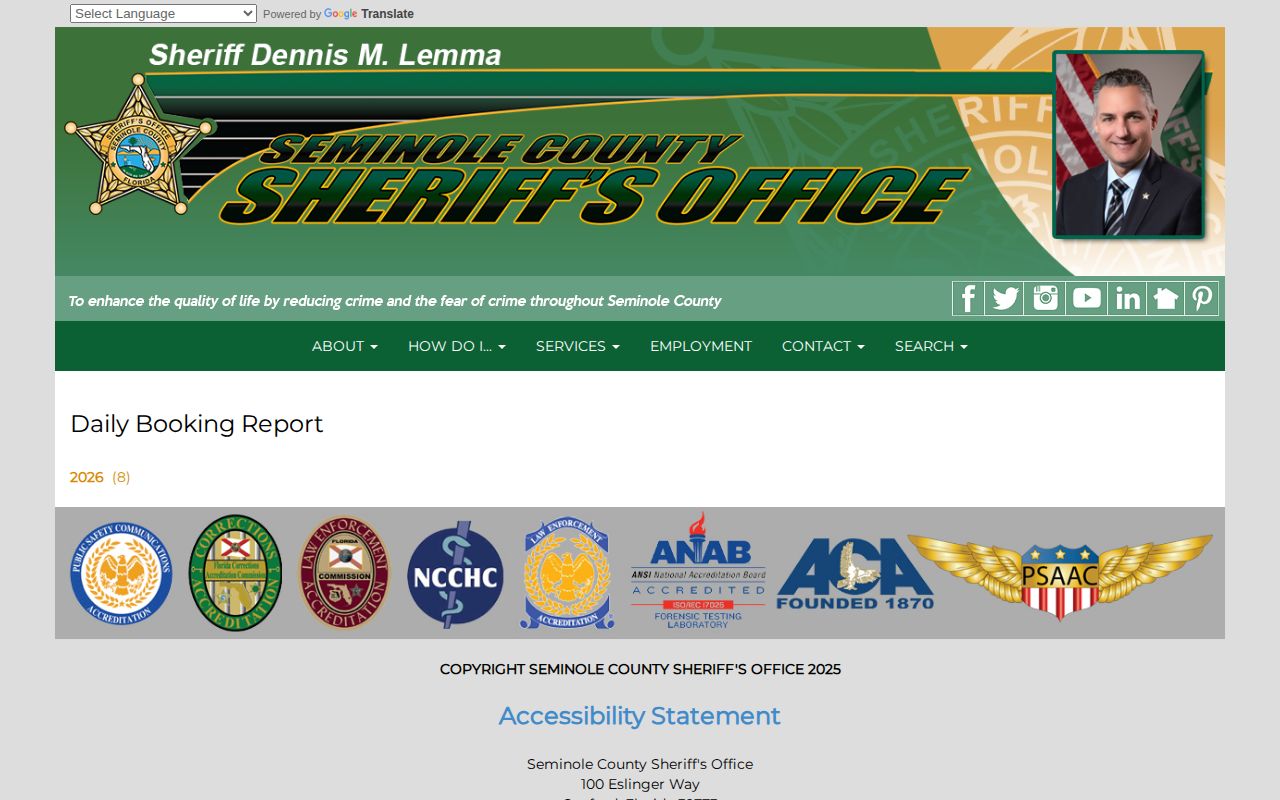
The archive sorts by date, but no archive promises completeness forever. Between issues, check Current Inmates. For a quick release, work through the Released and All Records filters. Then circle back to the later report. City news pages will not fill the gap, because Sanford, Altamonte Springs, and Oviedo run no full municipal booking blotter. Note: the arresting-agency field tells you who wrote the police narrative, while SCSO stays custodian of the booking sheet and photo.
Seminole County Booking Alerts
There is no verified SCSO jail app for phones. The responsive custody website is the official mobile route. SCSO victim-rights information points to VINELink for custody updates, including release or transfer alerts where participating data allow. VINELink offers no mugshot archive and no court outcome. Elsewhere, SCSO's Facebook feed, press releases, and The Dispatcher newsletter share selected public information, and Ring Neighbors plus CommunityConnect handle community safety and response updates. None of these is a booking app, which matters when a commercial product borrows a county-sounding name.
Seminole County Booking Custodians
One arrest, two offices. JEPCF keeps the booking sheet and photo. The arresting department keeps its own investigative report. The sheriff's daily report does list people brought in by all seven municipal police departments. Even so, the Sheriff's Public Information Unit cannot hand over a Sanford, Altamonte Springs, or Oviedo police report just because JEPCF booked the person.
- JEPCF booking sheet and photo
- SCSO corrections, the Public Records Unit, or PIU.
- Sheriff arrest narrative
- The Seminole County Sheriff’s Office.
- City incident or arrest report
- The municipal police department listed as arresting agency.
- Filed charge and disposition
- The Seminole County Clerk.
- State-prison profile
- The Florida Department of Corrections.
Sanford shows why this matters. There, city police, sheriff headquarters, the jail, and the first-appearance courtroom sit close together, yet each still generates its own separate records.
Florida Photos After County Booking
The Florida Corrections Offender Network covers felony offenders sentenced to state prison or state supervision. It excludes county jails and county probation. Search by name or a six-character DC number. Include aliases when useful, and pick the option that limits results to people with photos. The image, when one exists, sits on the offender detail page. The FDC search form makes the state channel's separate role plain.
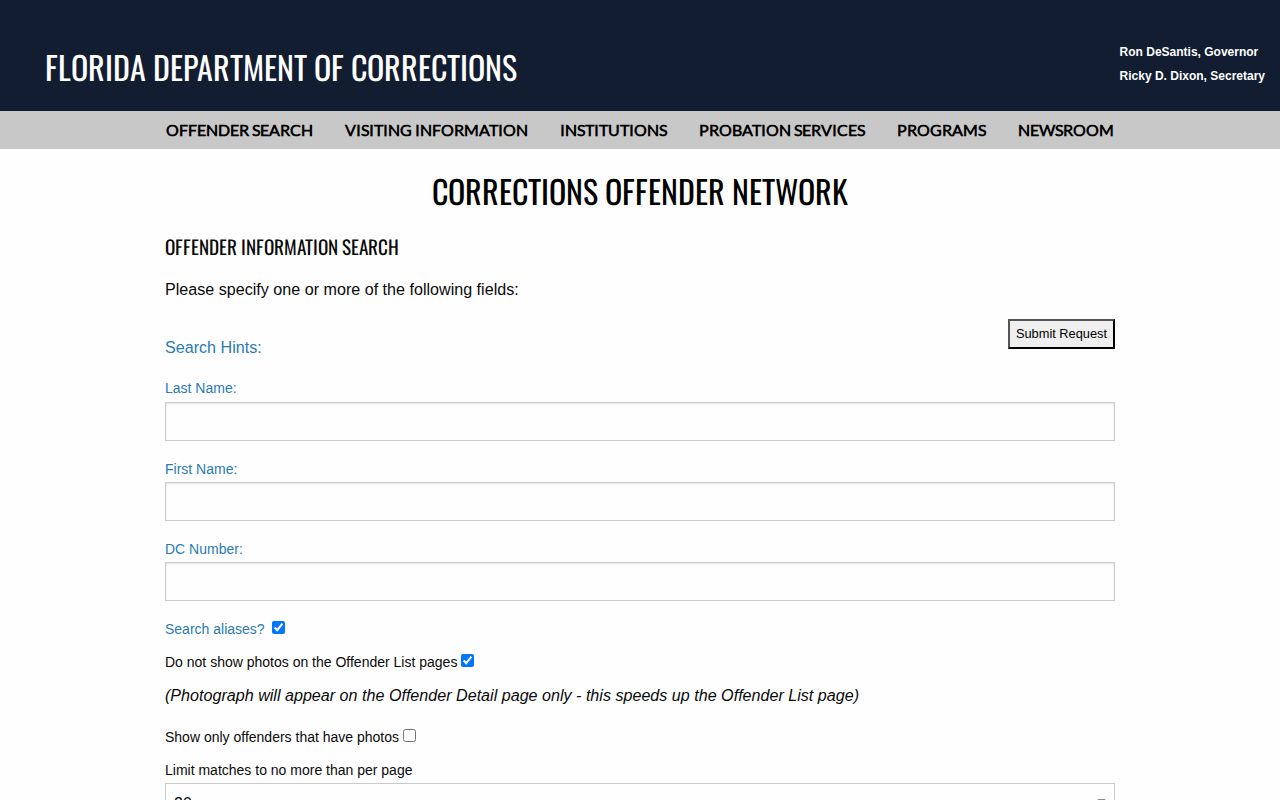
Where does a person belong? A pretrial county detainee stays in SCSO's system. A convicted felon awaiting transfer may still sit at JEPCF. FDC becomes primary after state reception. Federal cases split further. The BOP locator shows no public photos, ICE runs its own detainee locator, and USMS holds many federal pretrial detainees with no general public photo search at all.
Seminole County Busted Custody Stages
"Not on the roster" can mean several things. Match the source to the custody stage before reading a blank result as final.
| Stage | Primary path | What it establishes |
|---|---|---|
| Just booked | SCSO Current Inmates, then the next report | County intake and present searchable custody data. |
| Released from JEPCF | Released/All Records, dated report, PIU request | Past county booking, not dismissal or acquittal. |
| Case continues | Seminole Clerk criminal docket | Filed charges, hearings, amendments, and disposition. |
| State sentenced | FDC Corrections Offender Network | State prison or supervision status. |
| Federal or immigration custody | BOP, ICE, or responsible federal agency | A separate custody system, with BOP locator photos unavailable. |
Transfer and release move records between systems. Save both the old booking number and the later case number so you can link them without leaning on a face.
Seminole County Booking to Court
Booking is only the start. An arrest lands the person at the James E. Thomas Correctional Facility, where staff take a photo and open a jail record. From there, the name may appear on a roster or in a report. If no release comes quickly, a first appearance follows. Prosecutors then look at the case and can drop the charge, file something different, or amend it. The court side moves through hearings toward a final outcome, whether that is a dismissal, a plea, or a judgment after trial.
- Booking
- Jail intake that records identity, alleged charges, custody, bond data, and a photo.
- First appearance
- The initial judicial review of rights and release for an unreleased person.
- Bond
- A release condition, not punishment or a guilt finding.
- Disposition
- The recorded resolution of a court count, which is not always a conviction.
- Expunction
- A court-authorized process that destroys most agency copies while FDLE keeps the confidential copy allowed by law.
Start with the Clerk's online search. Use whatever name or case number you have. Then match the dates. Read each count on its own, since a single case can end several ways at once. If the online file will not load, the Clerk wants criminal-record requests sent to criminal@seminoleclerk.org instead.
Seminole County Busted Record Archives
A record can vanish from a website yet live on in a drawer. Florida's GS2 schedule sets retention by series and outcome. There is no one blanket mugshot rule. A photo may drop off the portal while the Sheriff's Office keeps its copy. Sealed, expunged, or exempt files stay withheld even when the agency retains internal material.
For older records, start with SCSO Records or PIU and the Clerk. Give them the name, a rough date, any booking or case number, the arresting agency, and the exact item you want. Municipal reports belong to the city that wrote them. Ask whether the series is still onsite, was legally destroyed, or moved. The Florida records schedules lay out the rules, and the State Archives takes only selected permanent government series.
So the Archives does not hold every Seminole County mugshot by default. Search its catalog by agency, series, and date only after you know where a record came from. A newspaper clipping or a commercial card proves nothing about an official master copy.
Busted Mugshots by Seminole City
City police keep their own reports. But anyone they actually detain goes into the county booking system instead. That split matters when you request records. The three CITY MAP pages lay out these local differences so you know which office to call.
- Sanford Busted Mugshots: SPD arrests booked at JEPCF, with a separate SPD Records Division request for the city report.
- Altamonte Springs Busted Mugshots: ASPD report requests and the county roster path for people taken into detention.
- Oviedo Busted Mugshots: OPD and city NextRequest details alongside the SCSO booking route.
None of the three city departments posts a full daily arrest and mugshot blotter. So split the work. SCSO covers county bookings. The named police department holds its own report. The Clerk carries the legal result.